
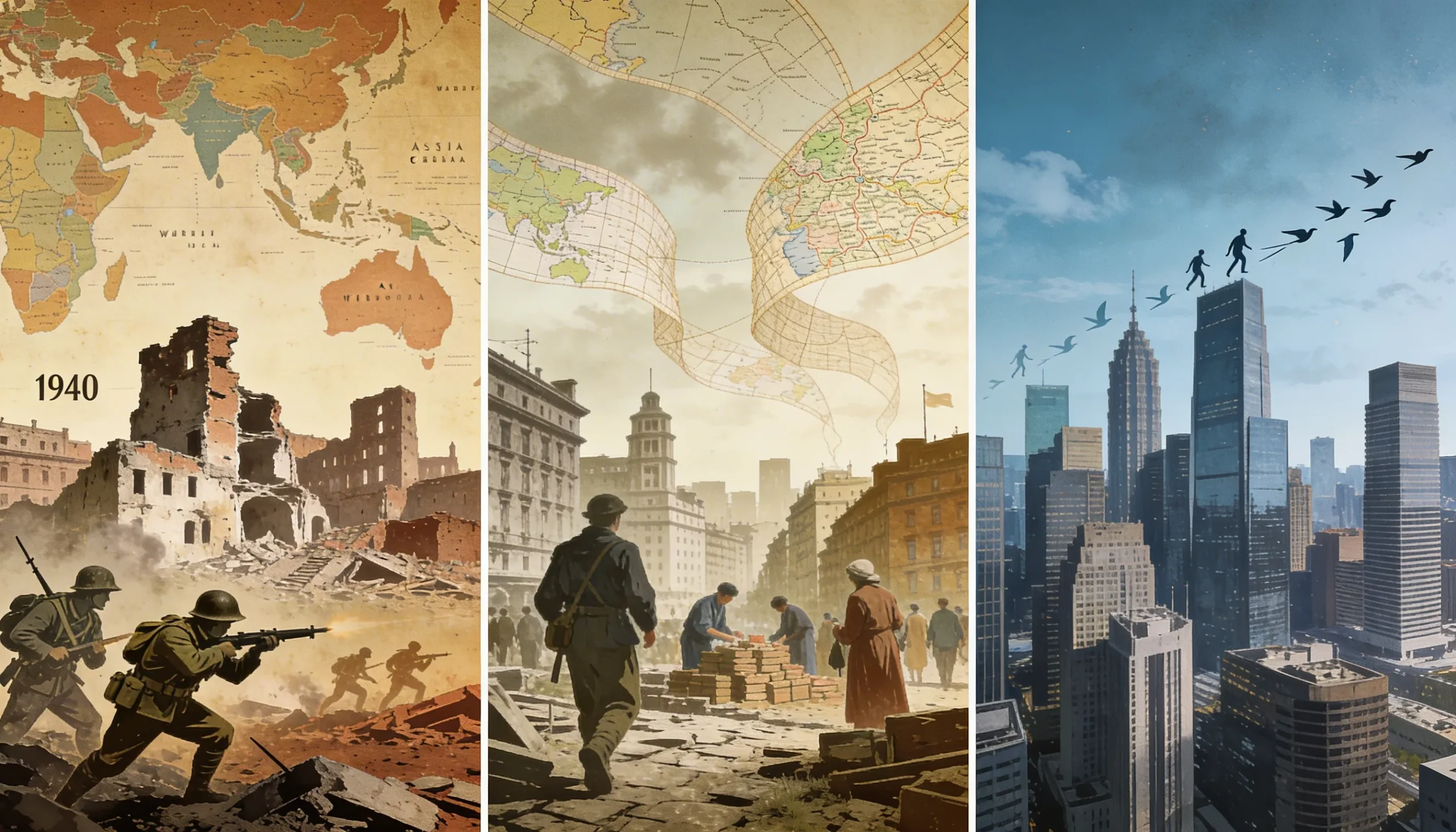
World War II is often shown to us through maps and arrows. Europe. The Pacific. Africa. We learn it in separate chapters, neatly divided by geography. But for many people who lived through it, the war was not confined to one place. It crossed borders, oceans, and identities. For some, one lifetime ended up stretching across three continents, not because they planned it that way, but because history pushed them there.
That is what global wars really do. They do not just redraw maps. They redirect lives.
Europe: Where It Began
For millions, everything started at home in Europe. Daily life shifted quickly. Governments tightened control. Ration cards appeared. Neighbors spoke more carefully. Young men were drafted. Families were split apart.
Even civilians far from battlefields felt the impact. Bombings reduced cities to rubble. Schools were interrupted. Childhoods changed almost overnight. Simple routines like buying bread, visiting friends, or going to work were shaped by sirens, shortages, and uncertainty.
By 1945, Europe was not the same continent it had been in 1939. Borders had shifted. Governments had fallen. Entire communities were gone or displaced. For many people, the idea of simply staying where they were no longer felt possible.
Home had changed. And sometimes, home was gone.
Africa: A Different World
Africa was not a battlefield in this story. It was something far more personal.
Before the war, my father had already built part of his life in South Africa, where he ran a car import business. It was a place of opportunity and enterprise, far removed from the rising tensions in Europe. That chapter of his life would later stand in sharp contrast to the destruction unfolding across the continent of his birth.
After the war, my own journey led me back to Southern Africa. I went to school there, surrounded not by bombed buildings or ration lines, but by open skies and a landscape that felt steady and expansive. The war had shaped me, but I was now living among people who had not endured its devastation firsthand, except for those who had served in the Allied forces. For many around me, daily life had continued without the ruins and air raid sirens that marked my earlier years.
In time, I moved north to Rhodesia, now known as Zimbabwe. There, I began a new chapter as a tobacco farmer. It was rural, demanding work, tied to seasons, soil, and patience rather than conflict and survival. The rhythm of farming life required endurance of a different kind. It was there that I married and where we welcomed our daughter into the world.
Africa became a place of growth and maturing, not through war, but through responsibility. It offered space to rebuild identity quietly, through work, family, and community. The contrast between war-torn Europe and the relative calm of Southern and Central Africa was profound. In that contrast, a new sense of direction began to take shape.
America: Starting Over
When the war ended in 1945, Europe was physically destroyed and emotionally exhausted. Millions of people were displaced. Cities needed rebuilding from the ground up.
For many, starting over somewhere else was not just a dream. It was a necessity.
The United States emerged from the war economically strong compared to much of Europe. For immigrants, it represented opportunity and stability. But arriving in America meant stepping into a new cultural landscape. The language was familiar, yet the customs, expectations, and opportunities were different.
The transition was not simple. People carried memories with them. Bombed streets. Ration lines. Loss. Those memories did not disappear just because they crossed an ocean. But they also carried resilience. A determination to build something new.
In a single lifetime, someone could move from wartime Europe to a quiet Southern and Central Africa to a new beginning in America. Each place left its mark.
Identity Across Continents
Living on three continents is not just about geography. It shapes identity.
War forces people to adapt quickly. To learn new rules. To survive in unfamiliar settings. Over time, those adjustments become part of who they are.
A childhood shaped by strict wartime conditions in Europe might create caution and discipline. Time spent in Africa might build endurance and a broader view of the world. A new life in America might encourage reinvention and hope.
But memory follows you. The sound of air raid sirens does not vanish simply because you move. The friendships formed in hardship do not fade just because the scenery changes. A person becomes a blend of places and experiences.
Sometimes that blend exists because of conflict. Sometimes it exists in spite of it.
When History Becomes Personal
We often call World War II a global conflict. The phrase is accurate, but it can feel distant. When you look at it through one person’s life, it feels very different.
The war shifted migration patterns that still shape communities today. It moved economic power. It weakened empires and changed political systems. But beyond those sweeping changes, it shaped individual lives in quiet, personal ways.
A child growing up in Germany in 1939 could not have imagined that adulthood might unfold on another continent. A soldier in Germany could not have foreseen sharing a life with his children in America decades later. Yet stories like these are woven throughout the twentieth century.
World War II did not just move armies. It moved people. And when people move, cultures mix, identities evolve, and new stories begin.
A Life Carried Across Continents
To live across three continents because of one war is to carry history within you. It changes how you see the world. You stop thinking in borders and start thinking in journeys.
Europe was the beginning. Africa was the maturing ground. America did offer renewal. Together, they form one continuous story shaped by events far larger than any one person, yet deeply personal at the same time. If you are curious about what it truly feels like to have one lifetime shaped by war across continents, from wartime Europe to Africa and eventually to America, Memories: My Life Story shares that journey in a deeply human way. It reminds us that while history moves nations, it is always lived one life at a time.