
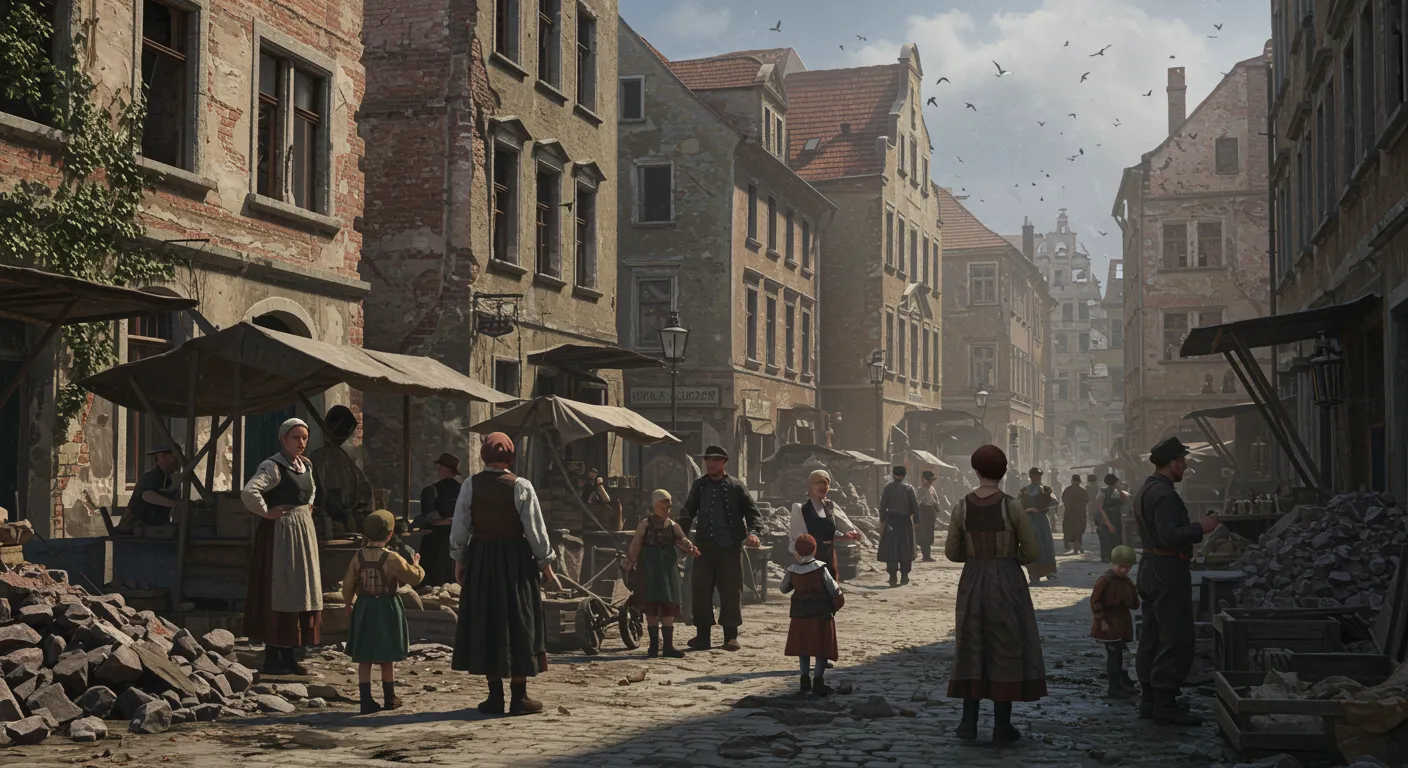
When most people think about World War II in Germany, they picture marching soldiers, Nazi rallies, bombed out cities, and the rise and fall of a dictatorship. What often gets overlooked is the quieter, more complicated story of everyday civilians. Mothers standing in ration lines. Children walking to school under air raid sirens. Fathers drafted into a war that seemed like it would never end.
Civilian life in Germany during those years was not one single experience. It shifted constantly between 1939 and 1945. It was shaped by propaganda, fear, routine, survival, loss, and eventually overwhelming devastation.
The Early Years: Confidence and Control
When the war began in 1939, daily life did not collapse overnight. In fact, early military victories gave many people a sense of confidence. State controlled media spoke of strength and unity. There was a widespread belief that the war would be short and decisive.
Propaganda reached into nearly every corner of life. Newspapers, radio broadcasts, school lessons, even films repeated the same themes of loyalty, sacrifice, and national pride. Speaking openly against the government was dangerous, so doubts were often whispered only within trusted circles, if at all.
At the same time, daily life began to change in practical ways. Rationing started early. Families received ration cards for bread, butter, sugar, meat, clothing, and fuel. Coffee was replaced with substitutes. New clothing became rare, so people mended what they already had again and again. Meals were stretched. Nothing was wasted.
Life went on, but it required constant adjustment.
Holding On to Routine
As the war dragged into 1942 and 1943, the strain became more visible. More men were drafted, leaving women to run households alone while also working in factories, offices, and farms. Children still went to school, though lessons increasingly reflected wartime priorities and ideology. Youth organizations became part of everyday life for many families.
Despite shortages and anxiety, people clung to routine. Shops opened when supplies were available. Trains ran when tracks were intact. Letters from soldiers were treasured and reread until the paper grew soft and thin. Birthdays were celebrated quietly at kitchen tables. Weddings still took place. Babies were born into a world already shaped by conflict.
Routine became a lifeline. Morning coffee, even if it was only a substitute. A shared meal at the end of the day. An evening radio broadcast. These small habits gave structure. And structure helped people cope.
But that fragile stability did not last.
Nights of Fire: The Air Raids
From 1942 onward, Allied bombing intensified. Cities like Hamburg, Berlin, Cologne, and Dresden were hit repeatedly. Air raid sirens became part of normal life.
When the alarms sounded, families rushed to basements or shelters, often in the middle of the night. Parents carried half asleep children through dark stairwells. People learned to tell the difference between distant thunder and the steady hum of approaching aircraft. The waiting was agonizing. Sitting in a shelter, listening for explosions, feeling the ground shake beneath your feet, could be worse than what followed.
Entire neighborhoods could vanish in a single night. Homes, schools, churches reduced to rubble. The next morning, survivors stepped into streets covered in dust and smoke. Some searched desperately for missing relatives. Others stood in silence, trying to grasp what had happened.
Living under constant threat changed people. Every quiet evening carried an unspoken question. Would tonight be the night?
Fear, Silence, and Moral Complexity
Beyond the bombings, there was another kind of fear. The regime maintained tight control. A careless remark could lead to arrest. Trust between neighbors was not always simple. No one knew for certain who might repeat what was said in private.
Experiences varied widely. Some Germans supported the regime wholeheartedly. Others complied because they felt they had no choice. Some resisted quietly in small, personal ways. Many focused on protecting their families and getting through each day.
At the same time, the persecution of Jewish citizens and other targeted groups intensified into deportation and genocide. Foreign forced laborers and prisoners of war were brought into Germany to sustain the war economy, often under harsh conditions. Civilian life existed alongside these realities. The war was not only something happening on distant fronts. Its moral consequences were unfolding at home.
The Collapse and Aftermath
By 1944 and early 1945, the situation had deteriorated sharply. Bombing raids increased. Food grew scarcer. Transportation systems failed. As Allied forces advanced from both east and west, millions of civilians fled, especially from eastern territories.
Long lines of refugees moved along frozen roads. Women, children, and the elderly carried what they could manage. Survival became more urgent than ideology. Promises of victory rang hollow amid ruins.
When the war ended in May 1945, Germany was shattered. Cities lay in rubble. Families were grieving or separated. The end of fighting did not bring instant relief. It brought uncertainty, occupation, displacement, and a long, difficult reckoning.
So what was civilian life really like in Germany during World War II? It was filled with contradictions. Pride and doubt. Routine and terror. Loyalty and fear. It unfolded in kitchens, classrooms, factories, and shelters. It was lived by ordinary people trying to make sense of extraordinary circumstances, often with limited choices and incomplete information.
If you would like to read a deeply personal reflection on growing up in wartime Germany and carrying those memories across continents, Memories: My Life Story offers an intimate look at how those years shaped one life long after the war ended. It is a reminder that history is not only about major events, but about the human experiences that stay with us forever.